
Mathematician Levent Alpöge chose an idea, Claude helped develop the proof, and others checked it. When a board weighs an AI result, who plays each of those roles?
What changed on 20 November?
On 20 November 2026, Levent Alpöge published the proof he had found with Anthropic’s Claude.
Think of prime numbers such as 2, 3, 5, 7 and 11. Sometimes two sit close together. Sometimes there is a long gap. Mathematicians can estimate how many primes there are up to a given number. In 1859, Bernhard Riemann proposed an idea that would pin down how far the actual count can stray from that estimate. A proof has to work however far you count. Clay’s explanation of the problem
Alpöge had studied the problem for years. He describes bringing two ideas together in a simpler example, then steering the work back to Riemann’s question. Claude suggested a key step he had not seen. They wrote the argument in Lean, a language in which a computer can check each mathematical step. Alpöge also wants to explain the argument in a form other mathematicians can readily understand. Alpöge’s own account
Two checks mattered. Did the steps follow the rules? And did they prove the very thing Riemann asked? On 21 November, the groups that run Lean and Mathlib, Lean’s shared library of checked mathematics, certified both for the classical Riemann hypothesis. Andrew Sutherland at MIT also documented independent checks of a wider result called the generalized Riemann hypothesis for Dirichlet L-functions. That name picks out a specific family of mathematical functions. Broader versions of the problem were not among the statements checked. The joint verification · The exact statements checked
A formal proof has a feature that a licensing decision rarely shares. Once experts agree on the statement to be proved, a proof checker can reject a step that does not follow. A transcript can be authentic yet leave open whether a supervisor was authorized on the day the applicant worked. Checking the arithmetic or verifying a quotation leaves that judgment with the officer. Ask what independent check exists for the particular task the supplier proposes.
A word of care. Alpöge works at Anthropic, the company that makes Claude. He says so on his own website. The checks so far are computer checks of the Lean files. Alpöge says he still plans to write the argument out so that people can follow it. The Clay Mathematics Institute has a separate prize process. It requires publication in a qualifying outlet, at least two years after publication, and general acceptance among mathematicians before considering a solution for a prize. A board can use the same habit. When a supplier reports a big result, ask who did the work, who checked it and what nobody has checked yet. Alpöge’s own website · Clay’s prize rules
December 2025 to November 2026
By December 2025, researchers were already asking AI for original ideas. OpenAI described a case in statistical learning theory where GPT-5.2 Pro suggested a proof and the authors checked it. The Riemann result shows how far such a partnership could reach eleven months later. To compare the models on common ground, we can also give them the same kind of puzzle. What GPT-5.2 could do · The November breakthrough
In ARC-AGI-2, the model sees examples of how a colored grid changes. It must work out the rule and apply it to a new grid.
- December 2025 GPT-5.2 Thinking
52.9% 52.9%- November 2026 GPT-6.2 Astra
95.8% 95.8%
On this test both models used the setting called “extra high”. That setting lets a model spend more time working before it answers. Their scores were 42.9 percentage points apart. The figures do not tell us how much computing time the two models needed, or how often they would get a license decision right. December results · November results
A second test is closer to an officer answering a call. Epoch AI, an independent research group that tests AI models, gave both models the same 1,000 factual questions without letting them look anything up. The December model answered 371 correctly. The November model answered 785 correctly and missed or skipped 215. The dates identify the model releases. Epoch used the older model’s “extra high” setting and the newer model’s “maximum” setting. If an applicant phones about a deadline, the officer still needs to open the rule. Epoch’s fact-checking test
A number like 95.8% leaves little room at the top of this particular test. A board has harder questions of its own. Can a model find the condition that applied on the day someone worked? Will it flag the missing page that could change the answer? How to read a model’s exam score.
The test makers now run a harder version, ARC-AGI-3. There the same model scored 70.3% with the organizer’s standard software. It scored 100% with software built to OpenAI’s design. The software around a model can change a score a great deal. Ask which software a supplier used. ARC-AGI-3 results
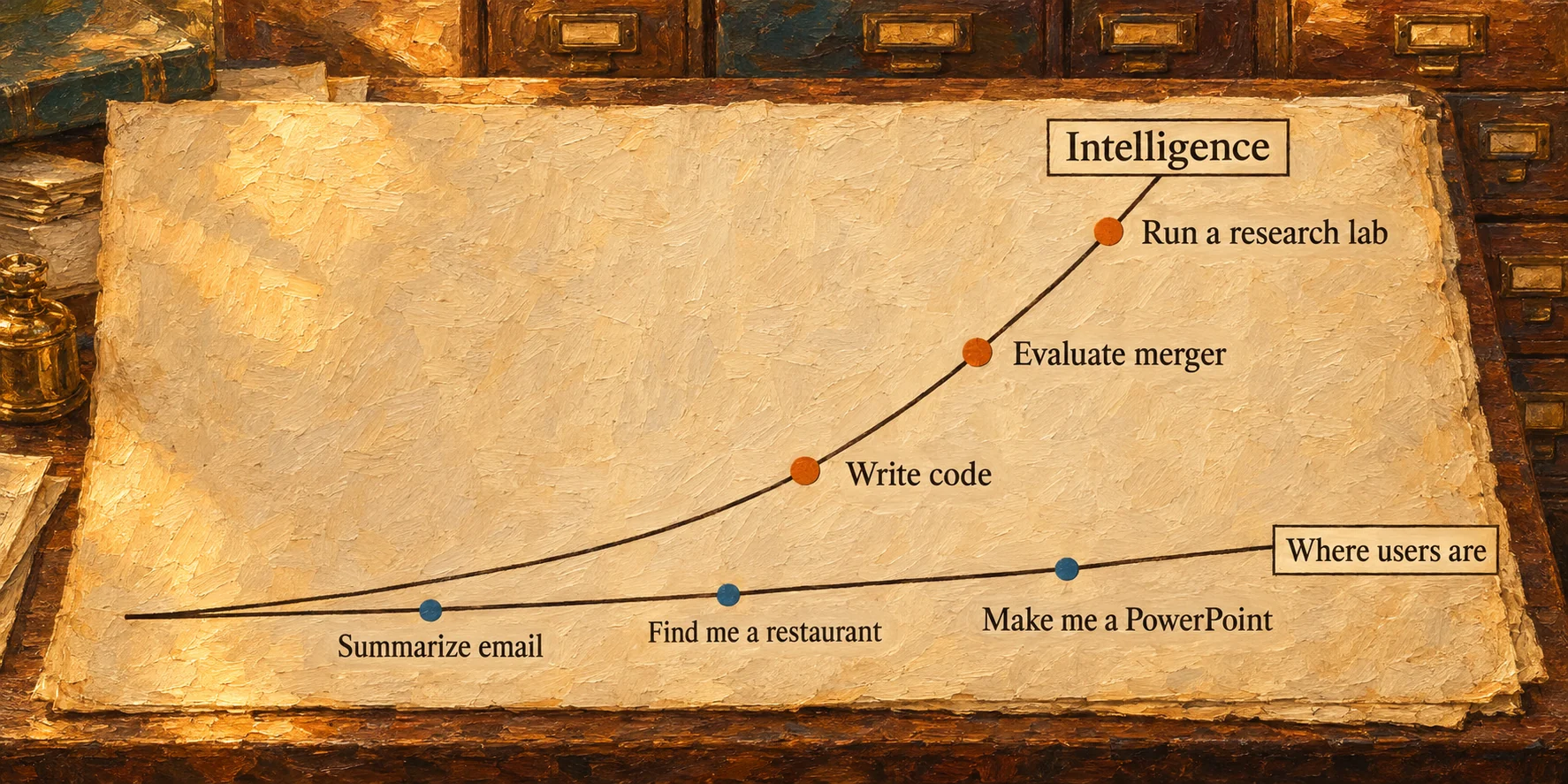
The figure below illustrates a question the benchmark leaves open. How much of a newly demonstrated capability reaches people doing ordinary work? A board could investigate by recording which tasks staff attempt, which results they can verify, and why they decline to use the tool for others. The benchmark measured none of these things.
When AI helps build the next AI
Google DeepMind gives a small example with a measured result. A tool powered by Gemini found a quicker way to do one calculation used in training Gemini. That calculation ran 23% faster. Across the whole training job, the saving was 1%. OpenAI later reported using early versions of GPT-5.3-Codex to help its engineers find training errors and interpret test results while building that model. The measured training gain · How the engineers used Codex
Now imagine a model that can choose the next experiment, run it, check the result and use what it learns to build a successor. Researchers at Anthropic call a system that can do all of this on its own recursive self-improvement. They say no system can do that yet. They also say their teams now hand a growing share of the building work to AI. People still set the goal. How fast a whole cycle could repeat remains an open question. How Anthropic researchers describe it
What if the people get better, too?
A better tool can help someone finish a file today. The larger gain comes if that person learns something they can use on the next file, spots a question nobody thought to ask and helps a colleague learn it sooner. The team gets better at teaching itself. That can happen even while the software stays exactly the same.
There is an early example in education. In a Harvard physics course, researchers tried two ways of teaching the same material. Students who used a specially designed AI tutor learned more on the lesson tests and spent less time on the work. Those tests measured what the students learned. A licensing board would need its own evidence about judgment on the job. Read the teaching experiment
A field experiment in high school mathematics found a different result. Students with an ordinary GPT-4 assistant did better on practice problems but scored 17% lower on a later unaided exam than students who had practised without AI. A tutor designed to guide students through the work largely mitigated that loss. The two studies used different learners, subjects and tutoring designs. A board training officers should measure both the work they finish with help and what they can explain afterwards on an unfamiliar file. Bastani and colleagues’ assisted and unaided tests
Imagine a licensing officer learning to review returning practitioners. A mentor makes up two cases with the same total practice hours. Both applicants name a supervisor. In one file the supervisor received approval only after the work was done. The officer makes a decision, then asks the AI to play the applicant and challenge the explanation. The mentor checks the reasoning against the rule. A week later, the officer tries an unfamiliar case unaided. Can they spot the issue and explain the decision in their own words?
Now let that officer help design the next exercise. They noticed the board’s form asks for the supervisor’s name but leaves out the dates. They suggest a clearer question and write a practice case to go with it. The next trainee starts one step further ahead. Each round improves both the people doing the work and the way the next person learns. Pay staff for that time and ask them which questions deserve the next round. Give the team time to practice.
How long does a generation take?
An engineer can estimate the time for a planned training run from the work to be done and the chips available. DeepSeek reported that the main training stage of its V3 model took less than two months on 2,048 chips. The team also spent time on earlier experiments and later training. A calendar can tell an engineer when a run should finish. It cannot tell them whether the model will pass a harder test when it does. DeepSeek’s training record
A release has a different clock. Anthropic announced its Claude Fable 5 and Claude Mythos 5 models on 9 June 2026, the 5.1 versions on 15 September and the 5.2 versions on 9 November. Those gaps were 98 days and 55 days. Several experiments can run at once. Labs can also improve an existing model between large training runs. Chips, electricity, cooling, failed experiments and time to check results all affect what reaches users. Starting several training runs in one month is not the same as finishing one, learning from it and building a better model a week later. Anthropic’s announcement dates
What December 2027 could look like
Imagine a December 2027 board meeting. Last year, staff asked an assistant to draft one letter. Before this meeting, they tested a tool on a fictional renewal. It spotted a mismatch in a school’s reply and pointed to the rule in force on that date. An officer checked both sources and noted where a call to the school would help. At the meeting, members read the officer’s report and ask which steps still need testing.
If capable new models arrive monthly, the board could keep a set of past cases with known answers and try each candidate on the same files. Give the team paid time to check errors, cost and time saved. Keep the model that serves applicants best.
If updates start arriving weekly, the board can keep its own timetable. A supplier could offer four updates while the board is still checking one. Staff need to know which version wrote a letter, where to find the original evidence and how to return to the previous version if quality falls.
A model may become better at finding patterns in reports of practice incidents while the board continues to permit only draft summaries for a named reviewer. To justify a wider role, identify the decision that would change, who has authority over it, and how staff would detect and correct an error before it affects someone.
Faster discovery also changes the work of IT. See how a regulator can prepare for a busy patching week.
Progress could also slow. A board that has trained its people, cleaned up its rules and learned to measure mistakes gains something under every timetable. Start with one trial the board can judge for itself.