

A licensing team sends requests for missing evidence faster, yet a month later more applicants are waiting. Systems thinking asks how the instructions, the applicants’ replies and the reviewers’ work together explain the delay.
What does a systems thinker do?
A systems thinker asks how one person’s decision changes the next person’s choices, and what happens when that pattern repeats. An intake lead can do this when a reviewer asks for a transcript a second time. The lead starts with a question each person can answer from experience. “At the moment you acted, what could you see? What were you waiting for?”
Take a fictional application. The applicant requested a transcript on Monday. The school recorded sending it on Tuesday. On Friday the reviewer opened the file, saw that the transcript was marked missing and asked for it again. All three accounts can be accurate. Which part of the journey has nobody described?
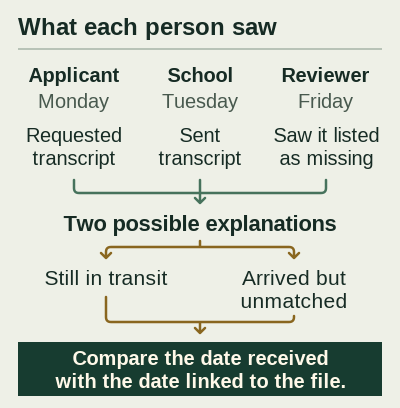
On a sheet of paper, put each event beside its date and the person or record that confirms it. Leave a gap between “school sent it” and “reviewer could see it.” The transcript might have been in transit on Friday. It might already have reached the board and been waiting for someone to match it to the application.
Ask the intake lead to compare the board’s receipt time with the time the transcript appeared in the file. Suppose it arrived on Tuesday and was linked the following Monday. The team can now ask staff how they match incoming records. If the board first received it after Friday, follow the delivery with the school instead. A missing timestamp leaves the question open.
Try this on a second file that moved quickly. What did the people handling that file know sooner? Close the meeting by writing down the best explanation so far, one finding that would change it, and who will bring that evidence back. Comparing cases helps the group decide whether one applicant’s experience points to a recurring problem.
Decide whose work counts
A system is a set of parts that affect one another. If a request leaves an applicant unsure which document to send, a reviewer may get two replies where one would have done. Draw a boundary around the part you need to understand. For a licensing team, the boundary might run from the first application to the decision letter. Include time an applicant spends waiting for a school to send a record. A staff dashboard can show that file as waiting for someone else while the applicant still experiences a delay.
Invite an applicant, a reviewer and someone who answers the help line to trace a fictional case together. If you use a real case, first have an authorized reviewer remove identifying details and clear the example for the group. Ask where the work stopped, who could see the reason and what happened next. Write down what lies outside your boundary. For example, the team can change its instructions to a school. The school controls its own response time. Revisit the boundary if a change shifts work to a person you left out.
The UK Government Office for Science gives public teams practical ways to agree on a boundary and draw a map together. Read the systems thinking toolkit.
Count what builds up and trace what feeds back
A stock is an amount at a point in time, such as the number of open applications on Friday afternoon. A flow changes that amount over an interval. New applications add to the stock. Decisions and withdrawals take files out. A returned file that stays open creates more work inside the boundary. Counting it as another applicant makes the arrival rate look too high.
A feedback loop exists when a change eventually affects the thing that started it. Think of the applicant who calls to ask whether the transcript arrived. That call makes sense. When many people face the same uncertainty, their calls can change how long everyone waits. Trace one trip around the diagram to see how a queue could reinforce itself.
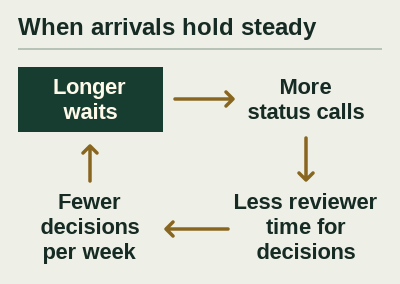
Pick one arrow to check. Ask who actually answers status calls and look at how much reviewer time those calls take in a week. If a separate help desk handles them all without involving reviewers, redraw the loop. If calls do interrupt reviews, try giving applicants a date for their next update. Alongside call volume, check waiting times and whether applicants who rely on the phone can still reach someone.
A balancing loop can bring a stock back toward a target. For example, when the queue grows, a supervisor can assign a trained reviewer to it. The extra reviewer can finish more cases and bring the queue down. Mark the delay on the map. It may take two weeks to train or transfer that person. Also mark the queue they left. Its wait may rise. A helpful change in one queue can create a problem in another.
Find a place where a small change can matter
A leverage point is a place where a change can affect the behaviour of the wider system. Consider a complaint office where people call twice because they have no confirmation that the office received their report. A clearer receipt and a date for the next update could reduce repeat calls. A speed target for the help line could shorten each call while leaving the reason for the calls in place. Test either idea against actual call reasons.
AI can make a single step cheap to repeat. A tool that drafts ten evidence requests in a minute can also send a wave of work to applicants and reviewers. Trace what each request asks someone else to do. Examine the rule that triggers the request and the information applicants receive before they submit. Donella Meadows describes both rules and access to information as places to intervene. Read Meadows on leverage points.
Workshop, steps 1 and 2. Draw and count
1. Agree on one question. Use this fictional exercise with a reviewer, an intake worker and a person familiar with the applicant experience. Ask whether one clearer instruction could reduce repeat document requests without increasing missed requirements. Draw the path from first submission to decision. Mark the place where a file goes back for more evidence. Ask each person what information is available there.
2. Reconcile one full week. Start Monday with 80 open applications. During the week, 30 new applications arrive and staff issue decisions on 24. Assume there are no withdrawals or reopened cases. Friday closes with 80 + 30 − 24 = 86 open applications. Reviewers also send 12 requests for more evidence. Those requests leave the files open. Compare the calculated 86 with the actual end count before drawing a conclusion. If the pattern held for four weeks, the stock would grow by 24. Check the next weekly count to see whether the pattern continues.
What can that count tell an applicant about the wait? Little’s queueing result relates long-run averages. In a stable queue with an average of 90 open files and 30 arrivals a week, the mean time from arrival to exit is three weeks, provided all three measures use the same boundary. Our fictional week grew from 80 to 86. Dividing Friday’s count by that week’s arrivals would give an unreliable estimate of waiting time. Trace actual arrival and exit dates and report the age of still-open files. Slow exceptions can disappear from a count of completed cases. Little’s original result and assumptions.
Workshop, steps 3 and 4. Check a cause and run a small test
3. Challenge one arrow in the map. Suppose 8 of the 12 requests concern proof of the same qualification. Ask a reviewer to read the instructions alongside an applicant and identify the words that led them to different conclusions. Check another explanation too. If the correct evidence arrived on time but staff could not find it, changing the wording will do little. An AI partner can suggest other explanations using the fictional counts. The group decides which records or interviews could distinguish them.
4. Test one change. Try a plain-language example of acceptable evidence in the instructions for one application route. Keep the evidence requirement and the review standard the same. For four weeks before and four weeks after the change, count first submissions and how many need a repeat request for that item. Use the same follow-up period for every file, such as 30 days after submission. Keep a count of unresolved files and requests made later. Check for staff changes or seasonal changes in the mix of applicants.
Workshop, step 5. Decide what to keep
5. Read the result beside a balancing measure. In this invented pilot, 20 of 100 first submissions needed a repeat request before the change. Afterward, 12 of 100 needed one. The rate fell from 20% to 12%, a drop of 8 percentage points. A second reviewer checks 25 decisions from each period against the same evidence checklist. The reviewer finds one missed requirement before the change and two afterward. A faster process still needs a sound decision.
Before launch, the team agreed to pause expansion and review any missed requirement. In this scenario, inspect the affected files, use the normal correction process and revise any misleading example. Keep the established instructions available while you retest. A small audit gives limited evidence. It takes a larger sample and comparable cases to judge whether the new wording changed the error rate.
At the next review, bring the applicant and the help-line worker back. Share aggregate results. Show the queue size, waiting times, repeat requests and audit findings. Combine small groups or withhold details if someone could identify an applicant. Ask whether people who use paper or need language support can use the new instructions. Record who will make the next decision and when. A map earns its place in regulatory work when the team updates it after learning something it got wrong.